

Do You Really Need 10,000 Steps a Day?
First it was 10,000. Now it's 7,000. The number was never medical to begin with, which raises a more awkward question about why we were counting.

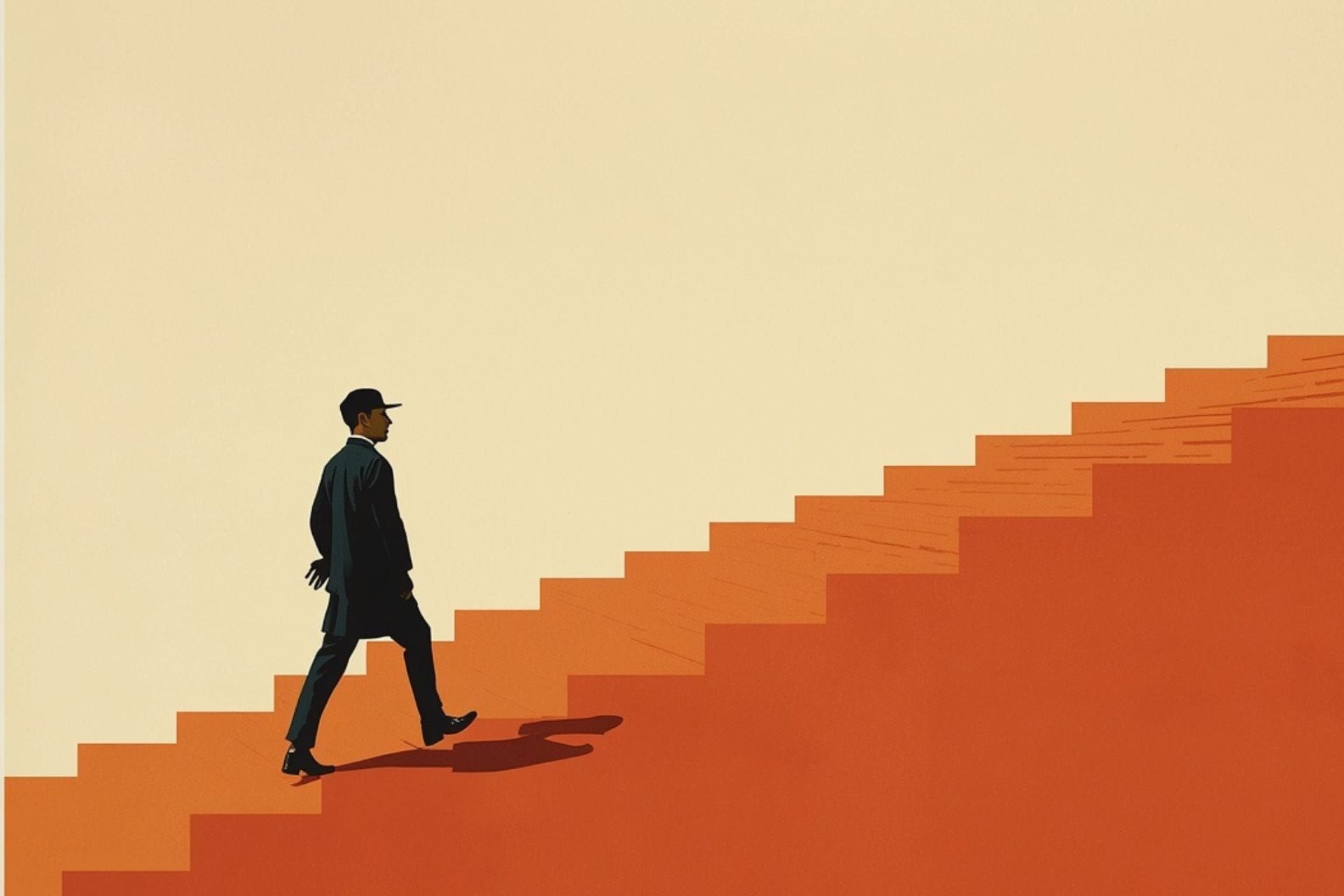
First it was 10,000. Now it's 7,000. I'll wait until it's 3,000, then start.
The short answer, for anyone who arrived here wanting one: no. A review published in The Lancet Public Health last year reviewed fifty-seven studies and more than 160,000 adults and found that most of the benefit is banked by about seven thousand steps. Compared with two thousand, seven gets you a 47% lower risk of dying of anything at all, and a quarter off your cardiovascular risk. Beyond that the line keeps rising, just less steeply. It's a hill, not a cliff. Ten thousand isn't wrong and there's no medal for cutting back to seven.
The number was never medical to begin with. It came from a Japanese pedometer sold in the year after the 1964 Tokyo Olympics, the manpo-kei, and it was called that partly because the character for ten thousand is said to look like a man walking. A visual pun. Sixty years of global health behaviour, and a poster in a doctor's waiting room in Watford, all resting on a Japanese marketing department noticing that a number looked like a bloke.
A pun set a target for the entire developed world in 1965 and a research consortium has finally marked it down by thirty per cent.
What I want to know is why the correction pissed me off.
Because it did. I read the story on my phone, standing in the kitchen, and what came back was the hall. Twenty minutes of it, most evenings that February, back and forth past the coats, checking the wrist, doing sums. Four hundred to go. Then two hundred. Then swearing under my breath because I'd stopped to look and the stopping doesn't count. The dog used to come and stand in the doorway and watch me. She'd give it a minute, decide I was an idiot, and go back to the sofa.
Somewhere in your fifties you start being issued numbers about yourself. Not the ones you chose, like the mortgage or the pension or the mile time you used to run. These come from machines and from doctors, and get read back to you as facts. Cholesterol, in millimoles, with a stated ceiling. Blood pressure, two figures, the second one apparently mattering more than anyone previously mentioned. Resting heart rate. Grip strength, if you're unlucky enough to be measured for it, which is a phrase I'd never heard until the year I heard it three times. Bone density. That HbA1c figure that sits just inside the range and gets described as "fine, for now."
None of these negotiate. You can't appeal a cholesterol reading. Nobody publishes a meta-analysis in 2026 announcing that actually 6.2 was always alright and we've all been unnecessarily worried. The numbers only move one way, and the way they move is towards the day someone uses the word "manage" about your body.
The step count was the only one I could manipulate, and it turns out it wasn't even bloody true. I'd been taking orders from a bloke in a marketing department in the sixties with pedometers to shift. I owe the dog a card from Clintons for the number of times I dragged her round the block again when we were both done.
Which raises the awkward possibility that I'd never really been walking for my health.
I bought the watch in the January after my fiftieth. Not a serious one. The mid-range model, on the reasonable-sounding grounds that I wasn't going to be running any marathons and didn't need the version that measures blood oxygen at altitude. It arrived in a box the size of a paperback with more packaging than seemed necessary for something that fits on a wrist. I charged it overnight and put it on in the morning and by eleven o'clock it had already told me something about myself.
The first week was genuinely good. I walked to places I'd have driven to. I got off a stop early. There's a stretch of the canal near us I'd not walked properly in years and I walked it twice that week.
The second week I started checking at nine in the evening, and the third week I found myself at 9,340 with the news on, calculating.
That's the moment the thing turns. Not the walking. The scoreboard. Because a step count doesn't measure whether you moved, it measures whether you complied. By the end of it I'd worked out that thirty-three laps of the kitchen island was five hundred, and that you could get them done while the kettle boiled if you didn't mind being seen doing it. I never told anyone I did that. I'm telling you now and it still sounds worse written down.
Then there are the mornings I've gone to work with the watch still on the charger, and my brain does this weird thing where it just gives up on the whole day. Oh well. No steps today. Not my fault, no need to take the stairs.
It also can't see most of what you do. Digging the garden. An hour of weights. Carrying an Ikea chest of drawers up two flights of stairs, which is the one that nearly finished me. Whatever it was, it went in as four hundred steps and an arrow pointing down, and I remember standing at the top with my hands on my knees, shirt stuck to my back, breathing like a man who'd done something, pissed off with myself because the watch had recorded almost none of it.
The strange thing is that I walk plenty at my mum's. She lives by the sea, and I go down every few weeks, and I've never once looked at my wrist while I'm there. Along the front, past the faded shelters and the scooters and the bandstand nobody's using, down as far as the pier and back, because the pier is where you turn round, those are the rules. I looked once, out of curiosity, and it was somewhere north of eleven thousand and I hadn't noticed doing any of it. At home I have a loop. Out of the estate, along the main road, past the Esso garage and the Red Lion, sometimes a pint on the way, back the same way. Nothing on it is worth arriving at.
Then a Tuesday where I hit four thousand and knew by lunchtime I wouldn't get near it. So I stopped looking. And once you've stopped looking for one day you've broken something, and the watch knows, and it sends you a weekly summary with an arrow pointing downwards. By March it was in the drawer in the kitchen, the one with the takeaway menus and the spare keys and the instruction booklet for a boiler we replaced in 2019 and still haven't serviced. I told myself I'd start again properly in the spring, which made sense, because who wants to walk in the cold.
There's a Fitbit from 2019, a Garmin from 2022, and something cheap off Amazon from 2024. At this rate I'll collect more watches than steps.
The official advice, for what it's worth, has never mentioned steps at all. The UK Chief Medical Officers ask for 150 minutes a week of something that makes you breathe harder, muscle work on two days, balance work as you get older, and less sitting still. That's it. It's unphotographable. Nothing to screenshot, which is presumably why nobody can name it and everybody could name the number invented to sell a pedometer.
The post I read it on was a man announcing he'd been let off. He said he'd spent years beating himself up over the number and could finally be happy with seven, and the word he reached for was freedom. Underneath, within a few hours, several dozen people had turned up to tell him what they walk. Twelve thousand suits me, I'll stick with it. Seven seems low, I feel better at eleven. Do more, not less. One man was on fifteen to twenty and said it had changed his life. Not one of them said well done.
The research says move a bit more than you did and it'll probably help, on a curve, with diminishing returns and no pass mark. What we heard was: new number. Seven. Go.
The other thing in the study, which nobody reported, is that the biggest gains are at the bottom. Getting from two thousand to five does more for you than getting from seven to ten. Which means the number was never aimed at the dog people or the golfers or anyone who walks to work without thinking about it. It was aimed at the man doing two thousand. And the thing least likely to help that man is a watch telling him at half past nine that he's 2,413 short of being who he meant to be today.
I got the watch out of the drawer last week. Dead, obviously. It took forty minutes on the charger before it would show me anything, and when it came on it wanted to know how my sleep had been for the last two years.
Dispatches from a life still in progress.
Work, money, culture and health, weekly. Free.